Best churn management software in 2026, sorted by the job it actually does
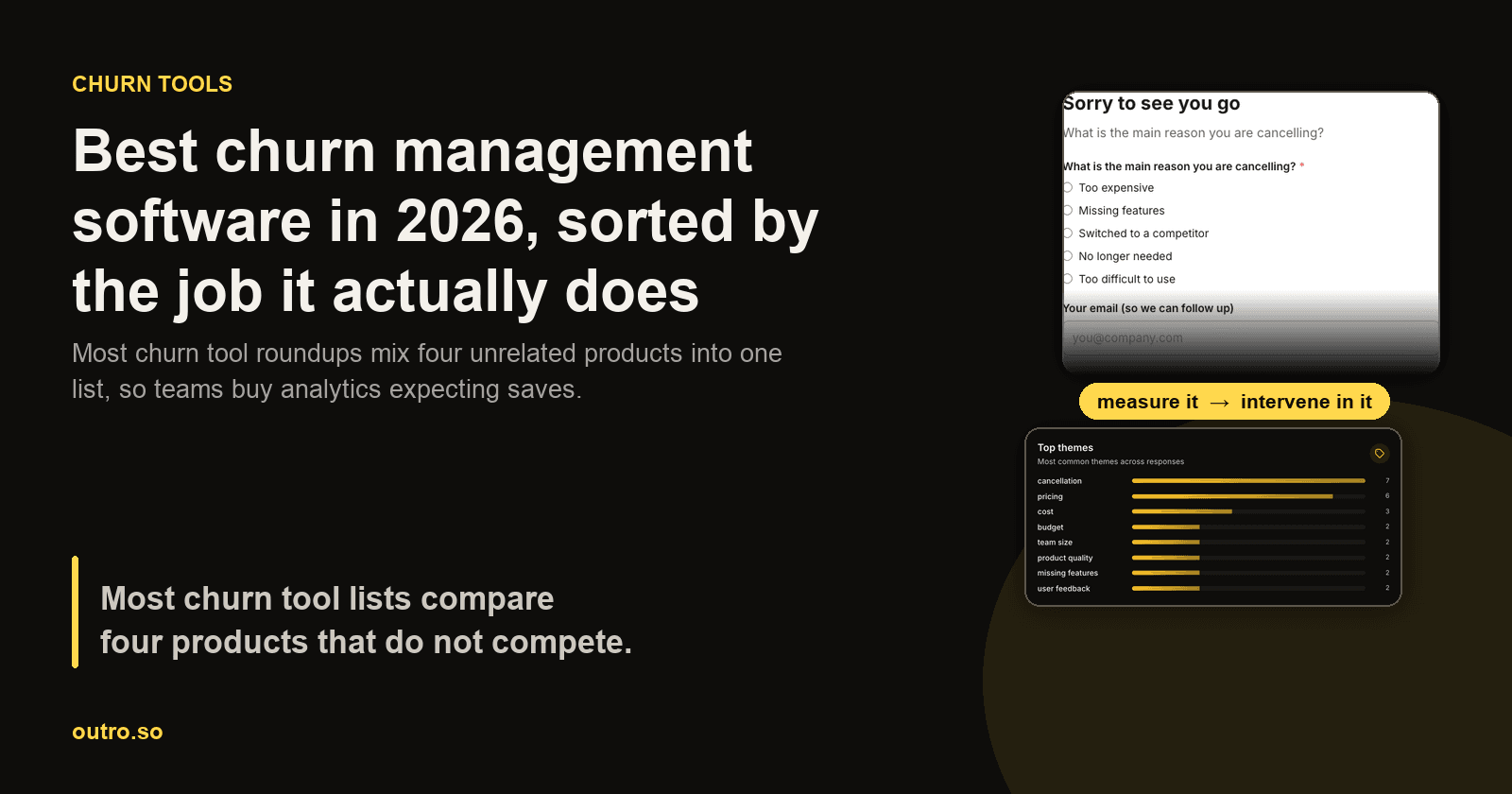
A founder told me they had bought churn software and still could not stop anyone leaving. They had bought a subscription analytics tool. It told them, accurately and in detail, that 18 people cancelled last month and that six of them had said the price was too high. It had no way to do anything about it, because by the time it saw the cancellation, the cancellation had already happened.
That is not a bad product. It is a good product bought for the wrong job. And it keeps happening because almost every "best churn management software" list on the internet puts four unrelated categories of product in one ranked column, then compares their prices as though they were alternatives to each other.
Disclosure, since you should weigh the rest of this accordingly. We build Outro, which is one of the tools in the interception category below. I have tried to write the piece I wanted when I was choosing, which means naming the cases where a competitor is the better buy and where Outro is the wrong answer. There is a section near the end doing exactly that.
Every price and feature claim here was checked against the vendor's own pricing page in August 2026. Where a vendor does not publish pricing, this says so rather than estimating.
The four jobs hiding inside "churn software"
Read the current roundups and you will find ChurnZero, Gainsight, Churn Buster, ProsperStack and Pecan AI in a single list. Those products do not compete. They solve four different problems that happen at four different moments.
- Measure why churn happened. Reporting after the fact. Tells you the size and shape of the problem.
- Intervene at the cancel moment. Sits between the cancel button and the billing provider, asks why, and offers something before the subscription ends.
- Recover failed payments. Handles involuntary churn, where the customer never chose to leave and their card simply failed.
- Manage accounts before they ever reach a cancel button. Health scores and playbooks for a human success team, which presumes you have one.
A tool built for job 1 cannot do job 2, no matter how good its charts are. A tool built for job 3 is solving a problem that has nothing to do with why customers want to leave. Buying across categories by comparing monthly price is how the founder above ended up with excellent reporting and no saves.
So work out which job you are hiring for first. The rest of this is organised that way.
Job 1: measuring why churn happened
Baremetrics is the reference tool here. It reads your billing data and turns it into MRR, churn rate, LTV and cohort reporting. Its Cancellation Insights add-on collects feedback with in-app popups and automates post-cancel follow-up emails.
The pricing deserves care, because it is the most commonly misquoted number in this category. Baremetrics plans start at $75/mo for Launch, covering $0 to $360K ARR, then $255/mo for Growth and $1,152/mo for Scale. Cancellation Insights and Recover are separate add-ons at $129/mo each, on top of a base plan. Lists that describe Baremetrics as "from $129/mo" for churn purposes are quoting the add-on in isolation. The real floor to get cancellation feedback is $75 plus $129, so a little over $200/mo.
What it does not do is intervene. In-app popups and post-cancel emails reach the customer either side of the decision, not during it. If your goal is a report, this is the right category. If your goal is a save, it is not.
Job 2: intervening at the cancel moment
This is the category most people mean by "churn tool", and it is where the real differences sit. All of these products put a step between the cancel button and the billing provider.
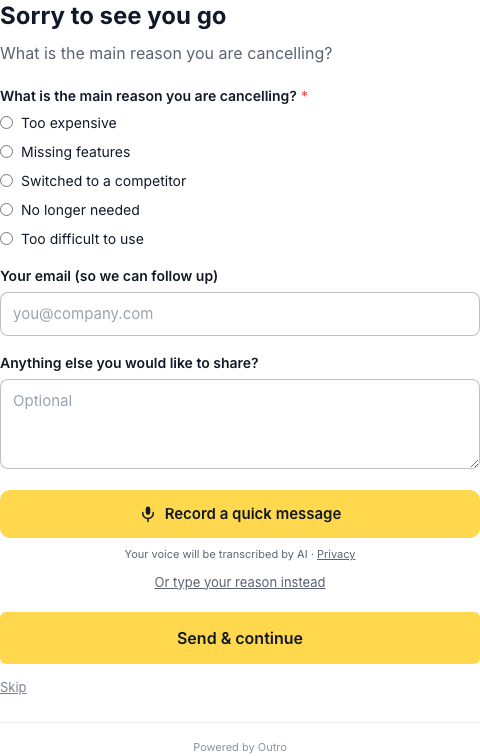
The interception moment. Whatever the tool, this is the screen doing the work, and the design of this one screen decides how much you learn.
Churnkey is the most complete retention suite of the group. Cancel flows, payment recovery and metrics on the entry plan, then A/B testing, segmentation and rules-based retry logic above that, then AI features on the top tier. Its Starter plan is $250 per month billed yearly and is gated by volume, described as available to teams with less than $5k/mo churn volume. Core and Intelligence are quote-only. There is a 14-day trial with no credit card.
Two details matter when you compare it. The volume gate means Starter is explicitly not for teams with larger churn, so growing past $5k/mo monthly churn moves you to a quoted plan. And the AI capabilities, including Feedback AI and AI-powered translations, sit on the Intelligence tier rather than the entry plan, so an AI comparison against Churnkey's cheapest plan is not comparing like with like.
ProsperStack offers hosted, customisable cancellation flows with deep billing integrations. Grow starts at $200/mo and covers 50 to 500 cancel sessions per month, Prosper is $750/mo for 500 or more, and Enterprise is custom. Note that 500 is the ceiling of the Grow band rather than an allowance, which is a distinction several roundups get backwards.
Its A/B testing and AI Autopilot offers begin on Prosper, and multi-language support is Enterprise-only. If you sell in more than one language, ProsperStack's entry tier will not cover you, and that is a pricing question rather than a feature question.
SubJolt is the budget option and is genuinely cheap. Starter is $0/month for up to 50 cancel sessions per month, and Pro is $99/month for unlimited sessions with a 30-day free trial. It integrates with Stripe, Chargebee and Recharge. It offers write-in reason sentiment analysis, though it does not describe that as AI, and it advertises no interface languages. For a small subscription business that wants a cancel flow with offers and does not need much else, the free tier alone makes it worth trying first.
Chargebee Retention is the enterprise end. Pricing is not public and the call to action is a demo request. Two things about it have changed recently enough that most comparisons are out of date. It is now presented as part of Chargebee Growth rather than a standalone product. And it is not restricted to Chargebee billing customers, since its own page describes integrating billing platforms including Chargebee, Recurly and Stripe. It has A/B testing including ML-based smart targeting. If you were avoiding it because you bill through Stripe, that reason no longer holds.
One thing to know if you are researching this category is that brightback.com no longer serves a website. DNS still resolves but the domain returns no HTTP response. Brightback became Chargebee Retention, so any roundup still listing Brightback as a current separate product is working from old notes.
Outro is the tool we build. It replaces the cancel button with a short spoken question, transcribes and classifies the reason with AI, then shows the save offer most likely to work before the cancellation goes through. Plans are $29/mo Starter, $79/mo Pro and $199/mo Scale, with a 14-day trial on every plan and no card required.
The specific bet is that a dropdown loses the information you needed. When somebody picks "too expensive" from a list, you learn nothing you can act on. When they say it out loud, you get the sentence behind it, and those sentences are usually about something other than price.
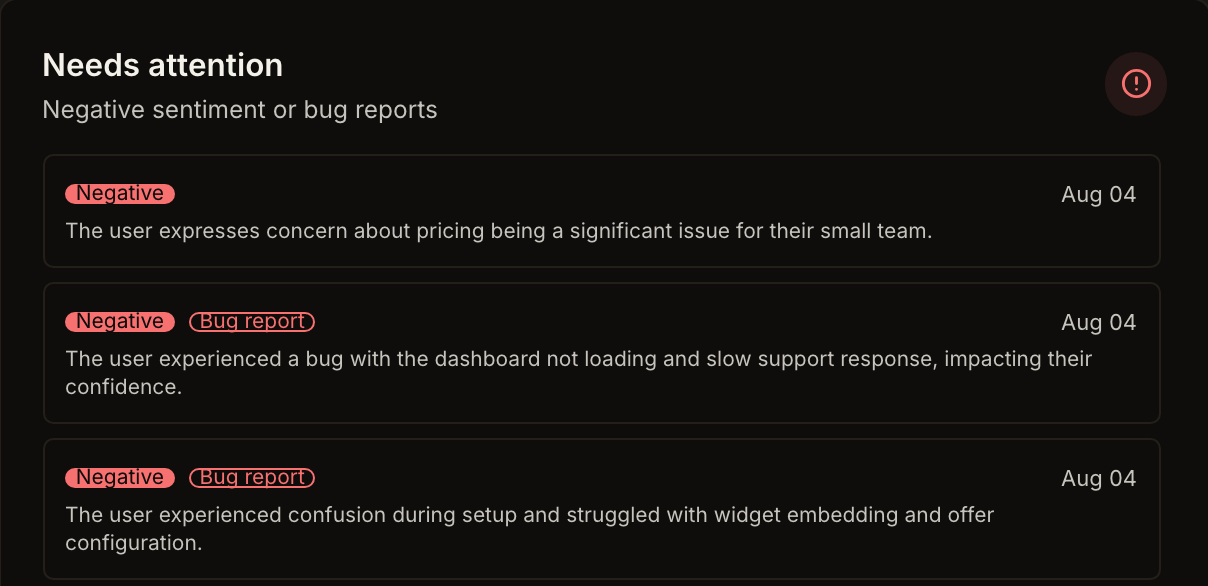
The output side. Each row is a real spoken answer, transcribed, classified and sentiment-scored, which is the part a fixed dropdown cannot produce.
I checked every vendor in this list for this, and none of the others advertise voice exit interviews. That is the honest scope of the differentiation. It is one capability, not a general claim of superiority, and there are cases where it should not decide your choice at all.
Job 3: recovering failed payments
Involuntary churn is a separate problem with separate tools. The customer did not decide to leave. Their card expired, or a payment failed, and the subscription lapsed. No amount of asking why they cancelled helps, because they did not.
Churn Buster specialises here, and Churnkey includes payment recovery from its entry plan, which is a genuine advantage of buying a suite. Baremetrics sells Recover as a $129/mo add-on.
Outro does not do this at all. If failed payments are your main leak, fix that first, and this article is not about your problem.
Job 4: managing accounts before the cancel button
ChurnZero and Gainsight are customer success platforms for B2B SaaS with named accounts and human CSMs. They track product adoption and account health so a person can intervene weeks before a renewal.
They are excellent and almost certainly irrelevant to a self-serve business. If your customers sign up with a credit card and never speak to anyone, there is no CSM to route a health score to, and the cancel moment is the only conversation you will ever get. That is precisely why the interception category exists.
The comparison, with everything verified
Checked against each vendor's own pricing page in August 2026. "Not advertised" means the vendor does not claim it publicly, which is not the same as absence.
| Entry price | Voice interviews | AI reason detection | Failed-payment recovery | A/B testing | Free option | |
|---|---|---|---|---|---|---|
| Outro | $29/mo | Yes | Yes | No | No | 14-day trial, no card |
| Churnkey | $250/mo billed yearly, under $5k/mo churn | No | On Intelligence tier | Yes, entry plan | On Core tier | 14-day trial, no card |
| ProsperStack | $200/mo, 50-500 sessions | No | AI Autopilot on Prosper | Revenue recovery | On Prosper tier | Not advertised |
| SubJolt | $0 up to 50 sessions, $99/mo unlimited | No | Write-in sentiment, not labelled AI | Smart payment retries | Not advertised | Free tier |
| Chargebee Retention | Not public, demo | No | Not explicitly | Not mentioned | Yes, incl. ML targeting | Sign up for free |
| Baremetrics | $75/mo plus $129/mo add-on | No | No | Recover add-on | No | Free trial |
The row that should decide most purchases is not price. It is which job the tool does.
When Outro is the wrong choice
Each of these is a real case where a competitor is the better buy than Outro.
Choose Churnkey instead if you need failed-payment recovery, reactivation campaigns and A/B-tested flows in one platform and the budget supports it. Outro has none of those three. A suite you only partly use still beats stitching three tools together for most teams.
Choose ProsperStack or Chargebee Retention instead if A/B testing your cancellation flow is the point. We do not have it. If you have enough cancellation volume to reach significance, testing offer variants will beat any qualitative insight, and you should buy the tool that tests.
Choose SubJolt instead if budget is the binding constraint. Its free tier covers 50 sessions a month at $0. If you are pre-revenue or validating, start there and come back when the reasons matter more than the cost.
Choose Baremetrics instead if what you actually want is subscription analytics. Outro reports on cancellations it handled, and nothing else. It is not an MRR analytics platform and will not replace one.
Do not choose Outro at all if you bill anywhere other than Stripe or Lemon Squeezy. That is a hard constraint, not a roadmap item. No Chargebee, Recurly, Paddle, RevenueCat or App Store. And on Lemon Squeezy, pause and downgrade offers auto-apply but discounts fall back to manual because of a limitation in the Lemon Squeezy API, so a Lemon Squeezy team should expect that manual step.
Three more limits, since they come up after purchase rather than before. Page count is plan-limited, with one cancellation page on Starter, up to five on Pro and unlimited on Scale. There is no conditional branching in the flow, so a follow-up question cannot appear based on which reason a customer picked. And a save is only counted after a 14-day grace window and only if the subscription is still live, which makes our numbers look worse than a tool counting saves at the moment of the click.
How to actually choose
A short procedure for not repeating the founder's mistake from the opening.
- Separate voluntary from involuntary churn. Look at how many cancellations were card failures rather than decisions. If it is most of them, buy job 3 and stop reading.
- Decide whether you need a number or a reason. If you cannot say what your top cancellation reason is, no dashboard will tell you, because the categories are supplied by you.
- Check the billing constraint before anything else. It eliminates more options faster than price does, and it is not negotiable in any of these tools.
- Count your monthly cancel sessions. Most pricing in this category is banded by volume, and the bands are where the surprises live.
- Then compare price, within one job, between tools that clear the first four.
If you want to size the problem before shopping, our churn calculator will tell you what a point of monthly churn is worth to you annually, which is usually the number that decides whether any of this is worth buying.
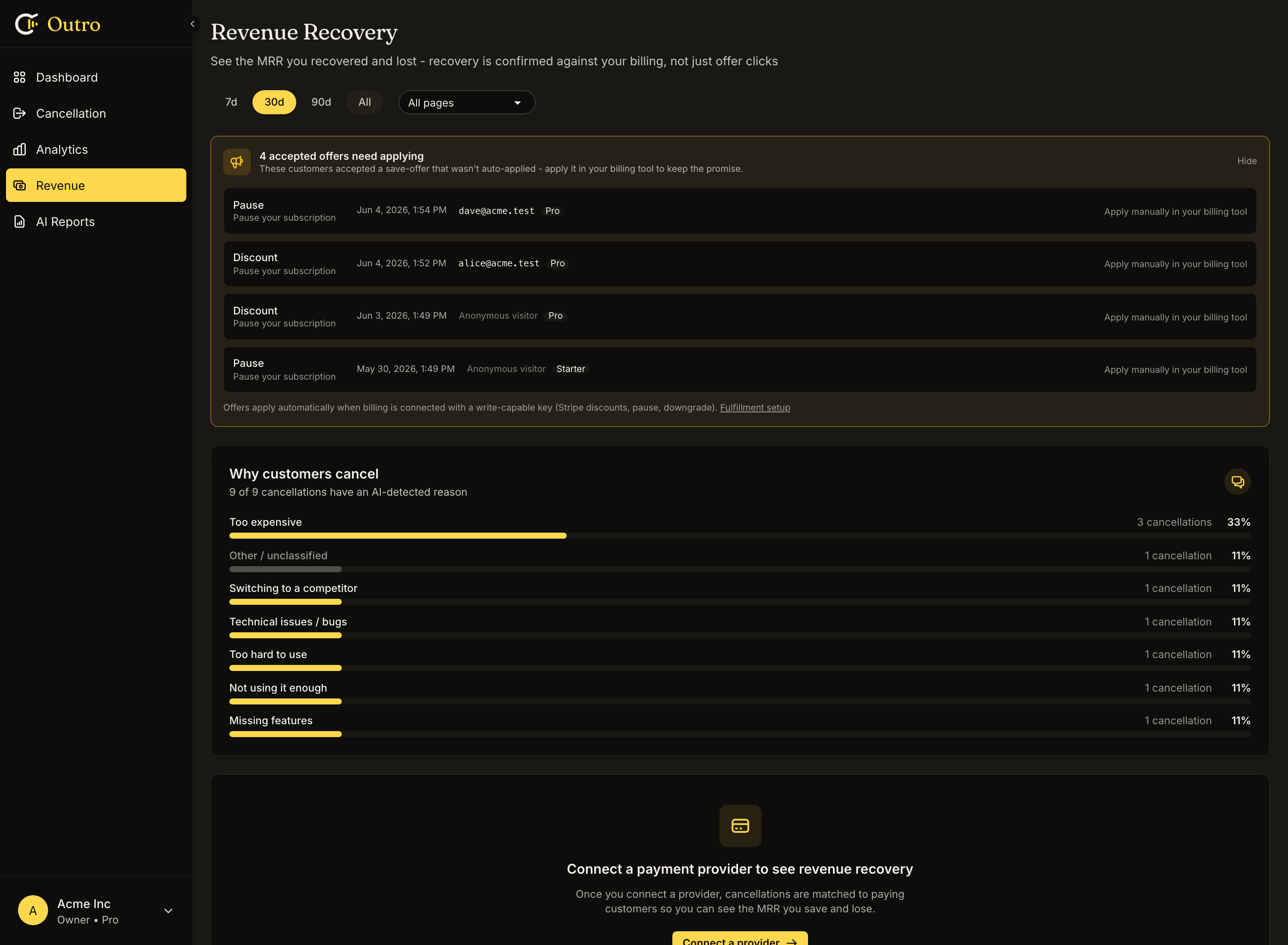
Verified saves rather than claimed ones. A save counts here only after a 14-day grace window and only if the subscription is still active.
Common mistakes
- Comparing an entry plan against a competitor's top tier. Churnkey's AI is on Intelligence, ProsperStack's A/B testing is on Prosper, and ProsperStack's multi-language support is Enterprise-only. Comparing feature lists without comparing tiers produces a table that is wrong in both directions.
- Quoting add-on pricing as platform pricing. Baremetrics at "$129/mo" is not a thing you can buy on its own.
- Assuming Chargebee Retention needs Chargebee billing. It integrates Stripe and Recurly, and this is the single most out-of-date claim in the current roundups.
- Trusting any list that has not been re-checked this quarter. Brightback's site is gone and Chargebee Retention has moved under Chargebee Growth, both recently enough that most published comparisons still have it wrong. Ours was checked in August 2026 and will also decay.
- Buying interception when your churn is involuntary. Ask what proportion of last month's cancellations were payment failures before you shop at all.
Where this leaves you
The category is four categories. Once they are separated, the choice gets much simpler, because most tools are immediately irrelevant to the job you have.
If your churn is mostly failed payments, buy payment recovery. If you have a success team and named accounts, buy a success platform. If you want reporting, buy analytics and accept that it reports rather than intervenes. And if your customers leave through a cancel button without ever telling you why, the interception category is the only one that gets you a conversation, and the choice inside it comes down to whether you need a full suite, the cheapest option, flow testing, or the actual sentence the customer would have said.
If it is that last one, try Outro free for 14 days with no card. And if one of the other four jobs described your situation better, buy that instead. A tool bought for the wrong job is more expensive than the one you did not buy.
Hear why your customers really cancel
Outro captures voice exit interviews on your cancel page, detects the real reason with AI, and shows the save offer most likely to keep them.
Start free trial